There are three opportunities to have issues in your home attended to:
- Tick sheet: This checklist is sometimes referred to as a 'snag list'. Your handover specialist and you complete the tick sheet on the day the house key are handed over to you. Once you are satisfied, you will sign the 'happy letter'.
- Retention form: Up to three months after receiving your keys, you will have the opportunity to note issues that may not have been apparent until after moving in.
- Quality inspection report: This can be requested at any time within five years following the key handover. It generally pertains to latent faults or evidence of deteriorating workmanship that could indicate a problem with the initial quality of the construction works.
Your tick sheet (First walk-through)
- What it is: A snag list to record any defects when you receive your keys.
- Who does it: You and your handover specialist.
- What to look for: Everything: Big faults (eg., no electricity, no hot water) and minor faults (such as cracks and chipped tiles).
- Time to allow: At least two hours to inspect your new home thoroughly.
How fast do things get fixed?
- Emergencies: Fixed within 72 hours (eg., no water or power).
- Minor faults: Fixed within seven working days.
Three-month retention repairs
- When: You will get an online form 45 days after moving in to record further issues.
- Why: To log any new issues you may have noticed.
- What is covered: Non-warranty items like sticky doors or loose window latches.
- One-time fix: This is a once-off service. Hereafter, repairs are your responsibility.
- Why it matters: This practice follows NHBRC recommendations to protect you and the developer.
Quality inspection for bigger issues (Ongoing after five years)
- What is covered: Latent defects due to poor workmanship, like major settelement cracks or recurring leaks.
- How it workds: Your report the issue. The quality inspector checks it. You get a formal report confirming whether they will do the repair or not.
- Accepted repairds: Once confirmed, the contractor will contact you and schedule an appointment.
- Repeat inspections: You can request more inspections if new issues appear later.
- Not covered: Wear and tear, age-related damage, storm damage. These are regarded as homeowner maintenance.
What is included in your warranties?
Standard one-year warranty covers:
- Stove: Does not cover hob glass, oven light bulbs, or insect/animal infestations.
- Geyser: Does not cover the element.
- Roof leaks: Storm damage is excluded.
- Electrical: Light bulbs are excluded.
Plumbing covers drain issues, but:
- Clogged drains: Covered only in the first two months, for excess silt or debris.
- Not covered if nappies, wipes, or foreign objects caused the clogged.
- After two motns, drain maintenance becomes your responsibility.
Large sewer blockages: If multiple houses are affected, report it to your local municipal council, as this is their responsibility.
Warranty faults: Cover for ONE year, you can report them at any time. Emergency faults are prioritised.
NOTE: All warranties become void if you carry out alterations or repairs of your own.
How to report faults
- You will get special links or QR codes at the key handover. Use these to log faults directly into your systm.
- This ensures fast tracking and real-time contractor updates.
Structural warranty
- Good news! Serious structural cracks are covered by a five-year NHBRC warranty.
- Not covered: Hairline cracks and normal settlement cracks.
Practical tips for first-time homeowners
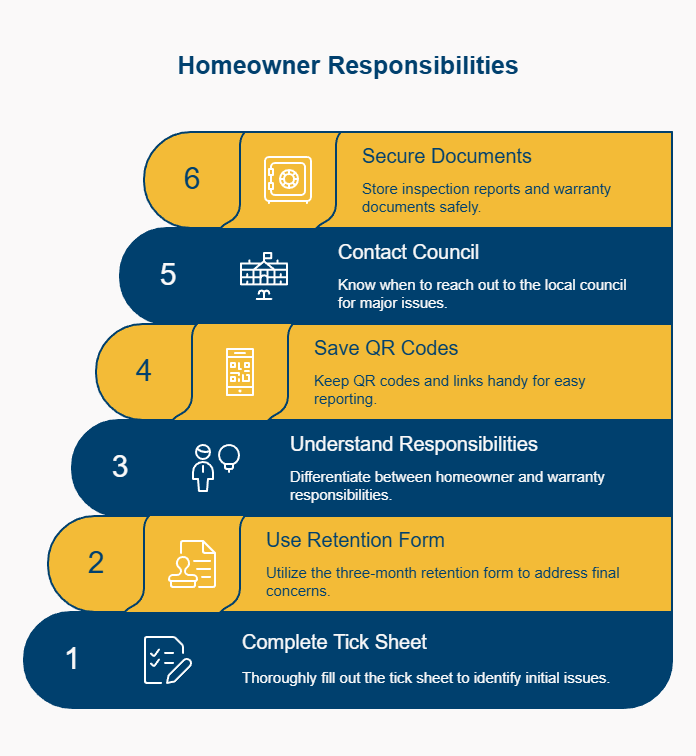
- Do your tick sheet properly, take your time to go through everything properly.
- Use your three-month retention form. Do not miss this final opportunity.
- Understand what your responsibility is vs what is warranty-covered.
- Save your QR codes and links for easy reporting.
- Know when to contact your local council for big water/sewer issues.
- Keep all inspection reports and warranty documents in a safe place.